Enabling Safe, Effective Staffing: An Independent Review of the Birthrate Plus Methodology

In April 2025 Birthrate Plus commissioned Birte Harlev-Lam OBE to chair an independent review of our approach to workforce planning in maternity services.

The review obtained views from over 160 members of the profession through a series of interviews, surveys and setting specific consensus building workstreams held between September 2025 and January 2026. Representatives from the Royal College of Midwives (RCM), Royal College of Obstetricians and Gynaecologists (RCOG), the devolved nations, senior maternity leaders from the Republic of Ireland, CEO’s, Directors and Heads of Midwifery, service leads and academics took part.

The review, published in February 2026, endorses the methodology underpinning Birthrate Plus approach to workforce planning and proposes ways in which the approach can be strengthened to reflect current practice.

Birte Harlev-Lam OBE, Independent Chair, Expert Advisory Panel said:

 “I am grateful to have had the opportunity to lead the Birthrate Plus methodology review as the Independent Chair. I really enjoyed the process, and I am thankful to everyone who engaged so openly and constructively throughout. I hope this report proves useful and timely, particularly in the current climate of significant challenge for maternity services, and that it contributes to improving midwifery staffing and supporting safer, more compassionate care for women and their families.” 

Birte Harlev-Lam OBE
MA, PgCert, DPSM, RGN, RM
Independent Chair
Birthrate Plus® Review

Key Insights

1. Birthrate Plus remains a robust and trusted workforce planning methodology.

The review confirms that the core approach and principles underpinning Birthrate Plus continue to be sound, credible and valued across maternity services. It provides a solid foundation for supporting safe and sustainable midwifery staffing.

2. Maternity services have changed significantly, and the tool requires updating to reflect modern practice.

Rising clinical acuity, growing social and psychological complexity, expanded safeguarding and Perinatal Mental Health (PMH) needs, and increasing administrative and governance workloads are not fully captured in the current model. Updating Birthrate Plus in partnership with services is necessary to ensure workforce planning reflects today’s reality.

3. Specific aspects of the methodology require enhancement to better represent contemporary roles and care pathways.

The review identifies several areas for development, including recognition of specialist midwives, newborn care complexity, community and outpatient demand, skill mix, and the transitional needs of newly qualified midwives. Improving transparency and usability of reports is also recommended.

4. Strengthening midwifery workforce planning also depends on wider system action.

The report calls for updated national guidance, clearer standards for specialist roles, consistent workforce uplift, and further research to build a stronger evidence base for safe staffing across the UK and Republic of Ireland (ROI). These system-level steps are essential to support Birthrate Plus and ensure consistent, safe maternity care.

The approach taken in the independent review

We sought to ensure that the review was as robust, open, and inclusive as possible within the time available. The review consulted maternity professionals working across the whole maternity pathway, as well as those working in research, education, representational and leadership roles across all four nations and the Republic of Ireland. Different perspectives were explored through multiple lines of enquiry and methods. This breadth enhanced credibility and ensured the findings reflected voices across roles, nations, and system levels. The review has sought to be transparent in methods and has action-oriented recommendations. Lack of published research focused on the maternity workforce, tasks, outcomes and safe staffing meant the review relied largely on expert and user views. In taking forward the recommendations we will focus on data collection and outputs, working with services and researchers and others.

{

I was delighted to be invited to join the Expert Advisory Panel, contributing oversight, constructive challenge, and research expertise. The resulting report delivers clear, actionable recommendations to strengthen workforce planning across maternity services.

Lesley Turner
Senior Teaching Fellow, Midwifery
University of Southampton, Expert Advisory Panel member
{

My involvement in this work is driven by a commitment to ensuring that the education of the future midwifery workforce remains closely aligned with the evolving needs of maternity services. Engaging in the development of the workforce model enables me to help bridge educational preparation with service realities, ensuring that our graduates are equipped to contribute effectively and sustainably to maternity care.

Carla Avery
Associate Professor of Midwifery and Head of Midwifery
Buckinghamshire New University, Expert Advisory Panel member
{

Being part of the Birthrate Plus review has reaffirmed how essential an evidence‑based approach to midwifery staffing is in the context of evolving population health needs. As acuity and complexity rise, ensuring the right midwifery establishment is fundamental to delivering safe, personalised, and equitable care for all women and families.

David Connor
Director of Midwifery
University Hospitals Plymouth NHS Trust, Expert Advisory Panel member

Board response

We are grateful to everyone who shared their insights, and we extend particular thanks to Birte for her leadership of this important work.

We are delighted that the review confirms the strength of the Birthrate Plus workforce planning methodology and highlights clear opportunities to strengthen and modernise our approach to reflect the evolving needs of women, babies and families. Midwifery is a dynamic profession shaped by continual changes in practice, policy, standards and population needs; the review’s recommendations will ensure that Birthrate Plus continues to fully reflect that.

The Birthrate Plus Board has accepted the review and all its recommendations, and work to implement them is beginning immediately.

Moreover, we are committed to continuing the partnership approach adopted by Birte in her review. We have asked Birte to continue to chair an independent Advisory Panel that will oversee the improvements we will be making. We will also work closely with services in delivering those changes and are inviting those interested in supporting the implementation projects to get in touch.

Richard Griffin, Chair of the board said:

“I would like to sincerely thank Birte and all the members of the profession from across the UK and the Republic of Ireland who contributed to the review. We are delighted that the review confirms that the principles underpinning Birthrate Plus remain sound, credible, and valued. ”
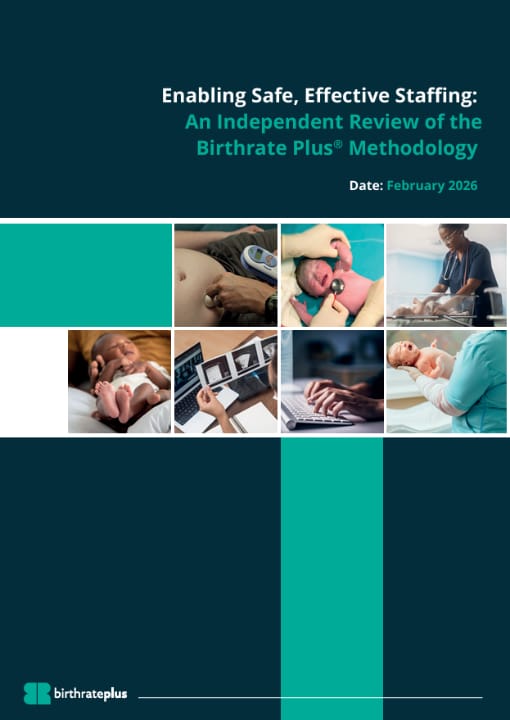
Methodology Review Report cover

Implementation Plans

We are now keen to move forward with the implementation of the recommendations.
If you would like to reach out to participate in the upcoming project delivery, please complete the submission form.

Any questions about the report please contact cathybritton@birthrateplus.co.uk

This field is for validation purposes and should be left unchanged.
Name(Required)
Email(Required)

The Methodology review committee

Members of the Expert Advisory Panel, September 2025